 Back to Listing
Arizona's economic future hinges on educational attainment
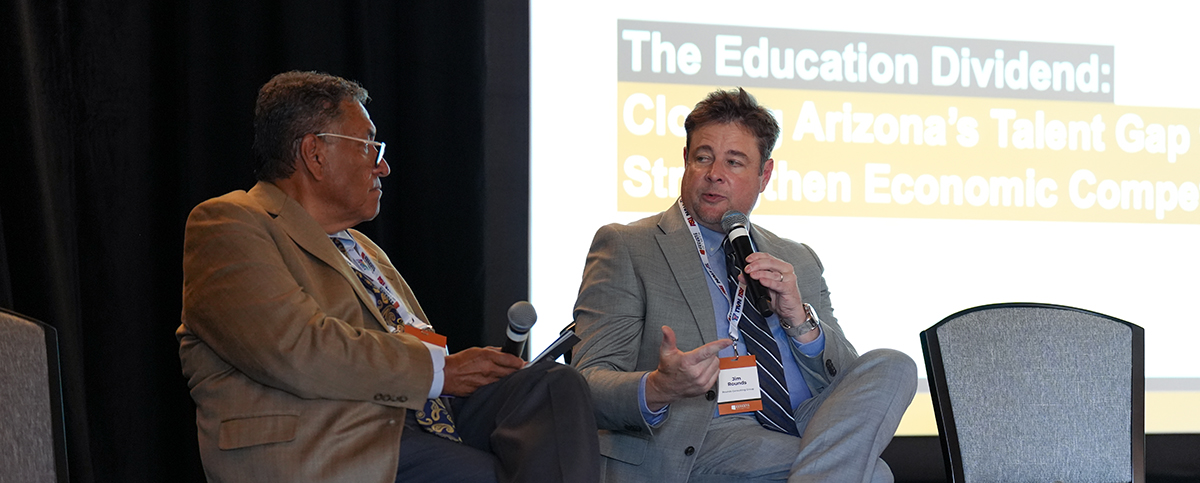
Regent Steve Peru and economist Jim Rounds discuss workforce development, economic competitiveness and the return on investment of public higher education at the League of Arizona Cities and Towns Annual Conference.
Arizona has spent the past decade building one of the fastest-growing economies in the country. New employers have expanded operations, major industries have invested billions of dollars and communities across the state have pursued growth strategies designed to strengthen their local economies. The challenge facing Arizona now is whether the state can produce enough talent to sustain that momentum.
That challenge was the focus of a discussion between Regent Steve Peru and economist Jim Rounds, president of Rounds Consulting Group, during the League of Arizona Cities and Towns Annual Conference. The conversation brought together local elected officials, economic development leaders and community stakeholders to discuss the connection between educational attainment and economic growth across Arizona.
"Talent is the currency of today's economy," said Regent Peru. "The earlier students can see a future for themselves in Arizona, the stronger our talent pipeline becomes. Connecting young people to education and career opportunities will help more Arizonans succeed while giving employers the workforce they need to keep our economy growing."
Arizona has emerged as a national destination for semiconductor, aerospace and healthcare investment. The challenge now is keeping pace with workforce demand. Employers can expand only as fast as they can hire the talent needed to support that growth. According to a forthcoming report from Rounds set to publish later this year, more than half of projected job openings in Arizona over the next decade will require education or training beyond high school, increasing the need for workers with postsecondary credentials and degrees.
During the conversation, Rounds shared preliminary insights from an upcoming report examining the relationship between educational attainment and Arizona's economic future. The research builds on an earlier study commissioned by the board and Arizona's business community that examined how workforce needs have evolved as Arizona's economy has grown.
The updated analysis found that Arizona's economy is projected to create demand for far more highly educated workers than the state currently produces. Even after accounting for in-migration, Arizona is projected to face an annual shortage of more than 10,000 workers with bachelor's degrees or higher each year. Those workers fill many of the positions businesses rely on to grow, including engineers, accountants, researchers, educators, healthcare professionals and managers.
"We need to make sure Arizona doesn't become a victim of its own success," said Rounds. "Our economy has tremendous momentum, but if we fail to close the talent gap, the state could lose $4 billion to $6 billion in tax revenue over the next decade and put that momentum at risk."
Rounds also quantified the economic impact of increasing educational attainment across Arizona.
His analysis found that reaching national averages in measures such as high school graduation, college enrollment and college completion would generate an estimated $1.3 billion in additional annual labor income and nearly $500 million in recurring state and local tax revenue. For local leaders, those gains translate into stronger economies, larger tax bases and greater opportunities for residents to find high-quality careers and build their futures close to home.
The conversation continued with a panel featuring Flinn-Brown Fellows Gail Jackson, president and CEO of the Economic Collaborative of Northern Arizona; Zach Yentzer, president and CEO of the Glendale Chamber of Commerce; and Heath Vescovi-Chiordi, director of economic development for Pima County. Their discussion explored how workforce needs are affecting communities in different regions of the state and how educational attainment influences local economic outcomes.
Jackson discussed the challenges and opportunities of attracting new industries to Northern Arizona. Yentzer shared the workforce challenges facing employers in one of the state's fastest-growing economic corridors. Vescovi-Chiordi highlighted the importance of talent development to industries that continue driving growth in Southern Arizona. Despite regional differences, the panelists agreed that educational attainment remains a key driver of opportunity and long-term economic competitiveness.
"Education is the lifeblood of the economy and competitiveness,” said Vescovi-Chiordi. “Businesses consider many factors when deciding where to invest, but access to talent often determines which communities can actually support expansion and keep their economies growing."
For the leaders gathered in Phoenix, the discussion underscored a broader point. Arizona's next phase of economic growth will depend on its ability to develop and retain the talent employers need. As businesses continue investing across the state, higher levels of educational attainment will help ensure Arizona has the workforce to capture those opportunities and keep that momentum moving forward.