 Back to Listing
Regents’ Grant-fueled research curbs dust pollution, improves soil health in central Arizona
ASU-led project delivers practical solutions for airborne dust in Pinal County with potential to scale across statewide agricultural sites.
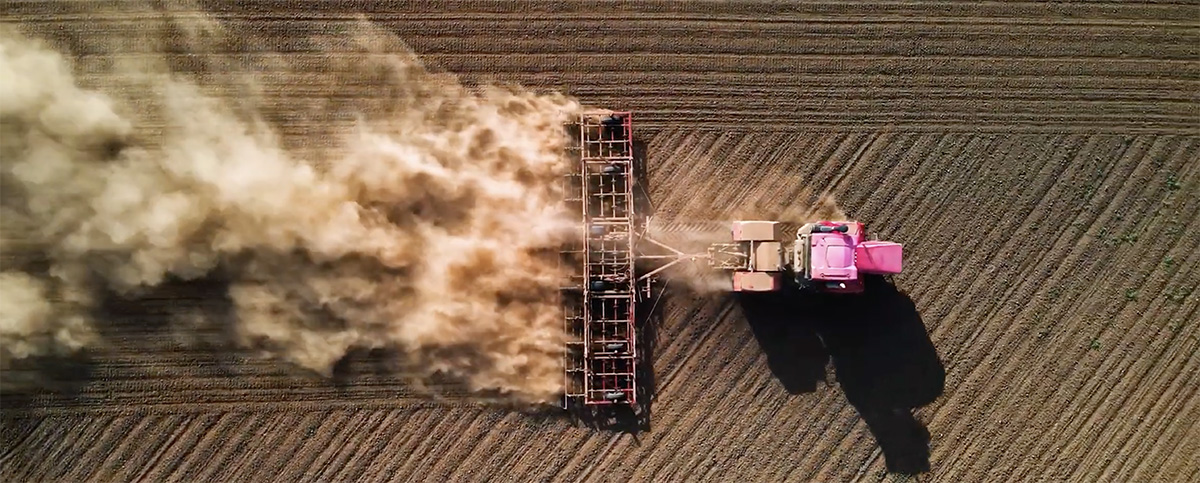
Across central Arizona, controlling dust often means keeping soil wet. Water trucks crawl across construction sites and fallow farmland, spraying to keep fine dust particles from blowing into nearby communities. The practice works briefly, but it relies on water, a precious resource in a hot, dry region, and must be repeated constantly as moisture evaporates in environments in extreme heat and low humidity.
New research led by Arizona’s public universities field‑tested more effective and practical ways to control dust while improving the efficiency and cost of dust‑management strategies. The results demonstrated faster dust reduction, improved soil function and fields that remain viable for future agricultural use.
The work, supported through a Regents’ Grant and led by Arizona State University faculty, tested affordable, on-the-ground methods to reduce windblown dust from unused farmland in Pinal County. Fallow agricultural fields are a major source of airborne particulate matter in central Arizona, contributing to air quality and public health concerns while creating compliance challenges for landowners and agencies responsible for dust mitigation. Blowing dust can also reduce visibility and affect transportation safety.
“Dust and water are both real constraints across Arizona,” said ABOR Chair Doug Goodyear “This research offers real solutions for how Arizona can keep land productive and reduce dust without putting more pressure on limited water supplies.”
Instead of relying on continuous watering, researchers focused on stabilizing the soil itself to prevent dust from becoming airborne. The project tested two complementary approaches: enzyme‑induced carbonate precipitation for rapid, short‑term chemical crust formation and engineered biocrust restoration for long‑term, self‑sustaining stabilization.
Field tests showed the treatments reduced dust emissions while helping preserve topsoil nutrients and improve overall soil health. Enzyme‑induced carbonate precipitation can be adjusted to quickly stabilize soil during fallow periods, particularly in areas most prone to dust events. Engineered biocrust restoration accelerates natural processes that normally take decades, strengthening soil surfaces and improving the long-term resilience of agricultural landscapes.
The project also developed a targeted management approach to help land managers and regulators determine which fields require active treatment and which can be managed through simpler practices. That distinction can reduce unnecessary interventions, ease the operational burden on landowners and support more consistent compliance with county and state air quality requirements.
“When fields go idle, dust becomes everyone’s problem,” said principal investigator Dr. Ferran Garcia‑Pichel. “We now have evidence‑based strategies to distinguish where land needs intervention, where it does not and how to manage both responsibly and effectively.”
The research was conducted in partnership with the Pinal County Air Quality Division and in collaboration with key regional land partners, which helped identify test sites and supported field monitoring. Researchers installed continuous air quality sensors and measured particulate matter during high‑wind events, allowing the team to assess real‑world performance rather than relying solely on laboratory data.
“Like many farmers in Arizona, this land has been in my family for decades and we cannot afford solutions that fail under real conditions,” said Pat Dugan, owner of Du Brook Dairy. “What makes a difference is when ideas are tested in the field, not just discussed. Working with the universities means we get practical, proven information, and that matters when both your land and your livelihood are at stake.”
As water constraints continue to shape land‑use decisions across central Arizona, approaches that reduce dust, conserve water and strengthen soil offer a more sustainable path forward for both agriculture and surrounding communities.
Funded through the Technology and Research Initiative Fund (TRIF), Regents’ Grants bring together Arizona’s public university researchers and state government agencies to tackle pressing challenges of greatest need and interest to Arizonans. You can learn more about the Regents’ Grants program and other projects funded by the board here.
Research contributors from ASU include:
- Dr. Ferran Garcia-Pichel, principal investigator
- Dr. Edward Kavazanjian Jr., co-principal investigator
- Dr. Matthew Fraser, co-principal investigator
- Dr. Pierre Herckes, co-principal investigator
- Dr. Brian Scott
- Dr. Emmanuel Salifu
- Katie Currier, graduate research assistant
- Salim Al Aufi, graduate research assistant
- Xi Yu, graduate research assistant
- Amelia Stout, graduate research assistant
- Dr. Thuong Cao, graduate research assistant
- Dr. Jason Miech, graduate research assistant